
The Tax Strategy Hidden Inside Your Portfolio: The Power of Asset Location
Written by John Davis, CFP®, EA
Most investors tend to focus heavily on the specific types of investments they own or the total return they expect to receive. This focus is understandable considering the way most Americans consume financial media. Oftentimes though, maximizing your wealth is not a matter of what your investments earn, but what you actually get to keep.
Two major factors dictate what you keep over a lifetime: fees and taxes. While managing investment fees is relatively straightforward, optimizing your portfolio for tax efficiency requires a deeper strategic approach. This strategy is known as asset location.
Quantifying the Value of Tax Alpha
In the financial world, superior performance generated by a manager is often called alpha. When you save money through deliberate tax planning, you generate what advisors call tax alpha. This is a structural return bonus that has nothing to do with picking the right stock and everything to do with picking the right account container.
Major industry studies from institutions like Vanguard and Charles Schwab have attempted to quantify this benefit. Their research indicates that a disciplined, multi account asset location strategy can add anywhere from 15 to 75 basis points of annual after tax return.
The Compounding Power of 50 Basis Points: On a $1 million portfolio, adding an optimized 50 basis points (0.50%) of tax alpha translates to an extra $5,000 in your pocket in year one alone. Compounded over a twenty or thirty year retirement, this simple location adjustment can preserve six figures of wealth that would have otherwise gone to the IRS.
Tax Deferred Versus Taxable Accounts
To understand asset location, you first need to recognize the structural differences between the account types available to investors. The IRS segments investment accounts into separate tax categories, each carrying its own unique trade offs.
Tax Deferred Accounts
Vehicles like employer sponsored 401k or 403b plans and Traditional IRAs allow your investments to grow with taxes deferred. Income generated within these accounts, such as capital gains, dividends, and interest, is sheltered from annual taxation.
The primary trade off is that you receive an upfront tax deduction on your contributions, but every dollar distributed from the account in retirement is taxed at ordinary income rates. Roth accounts are a special variation where you receive no upfront deduction, but the growth is sheltered from taxation for your lifetime and passes to your heirs entirely tax free.
Taxable Accounts
Standard brokerage accounts, Transfer on Death accounts and individual stock accounts do not offer an upfront tax break. Income within these accounts is taxed in the year it is accrued and reported on a 1099 tax form annually.
The advantage here is flexibility. There are no penalties for early withdrawals, and the growth can qualify for preferential capital gains tax rates rather than higher ordinary income rates.
The Platform Friction Point
A common trap for mid-career savers is accumulating a massive balance in a Traditional IRA or pre tax 401k while filling it exclusively with high growth stocks. While the tax deferral feels good up front, you are inadvertently setting a tax trap for the future.
By placing your highest growing equity assets inside a pre tax account, you are effectively converting what could have been long term capital gains taxed at lower preferential rates into ordinary income taxed at rates as high as 37 percent upon withdrawal.
Understanding the Pillars of Investment Income
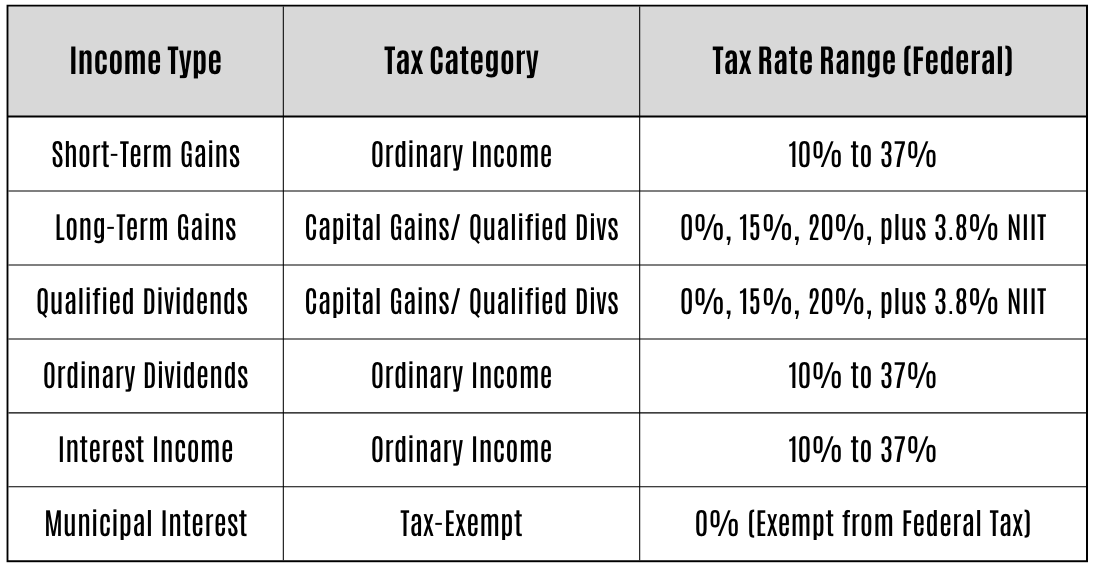
The investments held inside a taxable brokerage account generally produce three common forms of income. Each source is treated differently under the current tax code.
Capital Gains
Capital gains are broken into two categories based on your holding period. Short term gains apply to investments held for less than one year, while long term gains apply to assets held for one year or longer.
Long term gains receive highly favorable tax treatment. Federal rates cap out at 23.8 percent, which represents a 20 percent top tier capital gains rate plus a 3.8 percent Net Investment Income Tax. Many Americans can realize these long term gains at a 15 percent rate or even a 0 percent rate depending on their total income.
Short term gains enjoy no special treatment and are taxed exactly like ordinary income, moving in lockstep with your marginal tax bracket. For example, if a married couple with $150,000 of ordinary income in 2026 realizes a $50,000 short term gain, that gain will likely be taxed at 22%. If that same gain had been long term, the tax rate would drop to 15%, representing a savings of $3,500 in federal tax liability.
Dividends
Like capital gains, dividends are segmented into qualified and ordinary buckets. To be considered qualified, a dividend must be paid by a US corporation or a qualifying foreign corporation and held for more than 60 days. Most standard equity mutual funds and exchange traded funds meet this criteria for everyday investors with a large portion of dividends from these funds being classified as qualified. Ordinary dividends encompass all other payouts, including distributions from real estate investment trusts or corporate bond funds.
Qualified dividends receive the same favorable, lower tax rates as long term capital gains. Ordinary dividends are taxed at your full ordinary income tax bracket.
Interest Income
Interest generated from standard corporate bonds, certificates of deposit, and high yield savings accounts is taxed as ordinary income. The primary exception to this rule is tax exempt interest generated by municipal bonds issued by state and local governments.
While municipal bonds are federally tax free, they typically offer a lower stated interest rate than comparable corporate bonds because of this tax advantage. Investors must calculate the tax equivalent yield to see if the tax savings outweigh the lower payout.
Additionally, interest from US Treasury bonds is federally taxable but exempt from state and local income taxes. It is also important to note that while municipal bond interest is federally tax free, it is still included in your Modified Adjusted Gross Income calculations, which can inadvertently increase your Medicare premiums or the taxation of your Social Security benefits.
The Product Lineup: Tax Inefficiency Detailed
To implement an effective asset location strategy, you must be able to identify which specific investment products create the heaviest annual tax drag.
Active Mutual Funds and Capital Gains Distributions
Many investors are shocked to find a large tax bill at the end of the year even though they never sold a single share of their mutual fund. This happens because active fund managers constantly buy and sell stocks inside the fund throughout the year.
By law, the fund must pass those net capital gains onto you, the shareholder. These annual capital gains distributions can represent a severe tax burden when held inside a taxable brokerage account, making active mutual funds prime candidates for the protection of a tax deferred account.
Real Estate Investment Trusts
Real estate investment trusts, commonly known as REITs, can be good tools for diversification and income. However, the tax code dictates that REITs must distribute at least 90 percent of their taxable income to shareholders annually.
Because these distributions are almost entirely classified as ordinary dividends, they do not qualify for preferential capital gains rates. Holding a REIT in a taxable account exposes that income directly to your top marginal tax bracket every single year.
Fixed Income and Corporate Bond Funds
Similar to REITs, the regular monthly interest paid out by corporate bond funds is treated as ordinary income. If you are in a high tax bracket, holding standard bond funds in a brokerage account means giving up a sizable portion of your yield to federal and state governments.
The Core Strategy: Asset Allocation Versus Asset Location
Once you understand how these accounts and investments are taxed, you can begin coordinating them across your entire household portfolio.
Asset allocation is the process of deciding what percentage of your total wealth should live in stocks versus bonds based on your risk tolerance. Asset location is the strategic process of deciding which specific accounts should hold those assets to minimize your lifetime tax burden.
If your target asset allocation is 60% stocks and 40% bonds, looking at your portfolio at a high level might tempt you to duplicate that 60/40 mix across your 401k, your Roth IRA, and your taxable brokerage account. Doing so ignores an opportunity to build substantial tax efficiency.
Maximize Your Roth Accounts: Roth retirement accounts are some of the most powerful tax efficiency tools available. Because these accounts grow entirely tax free for your lifetime and can be passed to your heirs without tax friction, you should look to position your highest growth investments here, such as US and international equities. This allows your most aggressive compounding to occur completely outside the reach of the IRS.
Shield Inefficient Fixed Income: Traditional IRAs and pre tax 401k accounts will eventually face mandatory required minimum distributions that are fully taxable as ordinary income. Because fixed income investments typically generate lower long term growth and produce highly inefficient ordinary interest or ordinary dividends, housing your bond exposure here is often a prudent move. This fulfills a large portion of your target 40% bond allocation without generating an annual tax bill on the interest.
Optimize Your Taxable Brokerage: Your taxable account should ideally hold assets that benefit from preferential tax rates or provide natural tax advantages. This is the only account type where holding municipal bonds makes strategic sense. It is also an excellent home for broad market equity index funds that pay qualified dividends and generate low turnover, keeping your annual 1099 tax liability to a minimum.
Furthermore, taxable brokerage accounts receive a step up in basis upon the death of the account owner. If you hold highly appreciated stock in a taxable account for your entire life, the embedded capital gains tax liability effectively disappears for your heirs when you pass away, as their new cost basis resets to the current market value on your date of death.
The Rebalancing Escape Hatch
Beyond the annual tax savings, looking at asset location through a household lens provides an operational advantage when it comes time to maintaining your portfolio.
Over the course of a year, market movements will cause your portfolio to drift away from your target risk profile. If a strong stock market run pushes your 60/40 allocation up to a 70/30 allocation, a standard rebalance requires you to sell stocks and buy bonds to bring the portfolio back into alignment.
If you attempt to execute this rebalance entirely within a taxable brokerage account, selling those appreciated securities will trigger capital gains taxes, creating an unintended tax penalty for simply managing your risk.
By utilizing asset location, you can treat your retirement accounts as an escape hatch. Because trades inside a Traditional 401k or Traditional IRA trigger zero tax consequences, you can perform your risk management adjustments within those sheltered walls. You can sell equity funds and purchase fixed income funds inside the retirement account entirely tax free, preserving your target household allocation without sending a dime to the IRS.
Conclusion
While managing your asset location may not result in immediate, dramatic double digit spikes in your annual returns, these deliberate structural shifts create meaningful optimization over time.
By being intentional about where your investments live, you can quietly lower your lifetime tax bracket, preserve more of your compounding growth, and ensure that you keep a far larger percentage of your hard earned wealth.
